

The sad truth about Hi-Res Audio
Being an absolute fan of music, I am always on the prowl for great tunes, beautiful recordings and stunning music, with preferably a big dynamic in it. I love when music can be almost as silent as a whisper and then climb up to a mountain of sound... just to fall back down to the ambient sounds of a small brook. Just to give you an idea of how I love to listen to music.
I am a child of the 80's and loved bands like The Bugles, Roxy Music, Frank Goes To Hollywood, man I played their records many times. So I have been working on obtaining a legal library of great music in the best resolution possible alongside making use of online streaming services to just find new artists, bands, songs and more, all in the best possible quality.

The Genius Of Reimagining The Eighties
A few months ago I came across two distinct productions from Trevor Horn ( producer ) who made a set of albums . First one was " Trevor Horn Reimagines The Eighties ".
How this thing had escaped my views all this time alludes me but nonetheless it had and I was thrilled to find and listen to it. There's even an instrumental special CD of the same thing. WOW. The orchestra he had gathered to record these songs is just stunning and makes it all worth of having this ins the most pristine version available , just to appreciate the work of all the musicians more, after all, encoding sounds to make them smaller and smaller to fin in your back pocket is actually killing the music industry alongside... ponder about that !
Can't find it!
Sadly it's not easy to find any original CD let alone any digital rendition of this work that's worth listening to as the only versions I could find were bad MP3's and we all know how bad MP3 quality is ( no data over 16 kHz ). So this leaves me still out on the prowl for the best versions. If you have any, let me know, drop a message below please :)

Trevor Horn - Echoes Ancient & Modern
Shortly after I embarked on a journey to find more of Trevor's Albums I found another one, called Echoes Ancient & Modern. Another great album with amazing songs by just as much amazing artists.
This album sparked a renewed interest in Trevor Horn and his bands. We all know Trevor Horn as the ultimate sonic architect of the 1980s. He is an absolute perfectionist whose legendary productions for Grace Jones, Seal, and Frankie Goes to Hollywood are world-renowned for their incredible depth, dynamics, and high-fidelity standards.
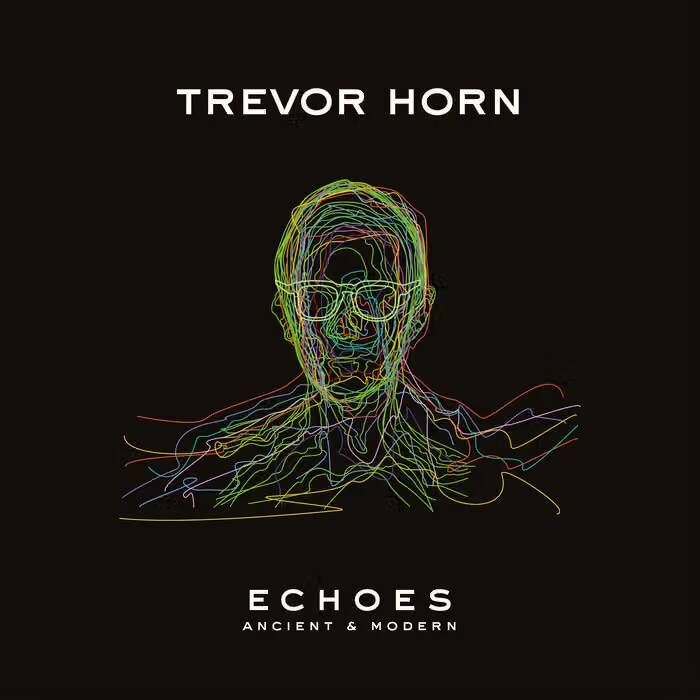
So, when his album Echoes – Ancient & Modern dropped, I sat down with my best headphones, ready for an audiophile feast. But what started as a celebration of pristine sound quickly turned into a technical mystery—one that led me straight to a spectrogram analyzer and the corporate mailboxes of Deutsche Grammophon, Bandcamp and even Trevor himself.
The Climax That Couldn't Breathe
My absolute favorite track on the album is track 4: Slave To The Rhythm, featuring the truly magnificent and soulful voice of Lady Blackbird. Before diving into the album, I caught a short promoclip of her singing this track on her Instagram page. Check out the link next to this article.
You'll agree with me that this sounds absolutely stunning—raw, crystal clear, and pure goosebumps.
Riding The Tidal Wave?
So I hooked up a Tidal account to check out their offerings in 24 Bit 192 kHz.
However, when I streamed the full track via Tidal in the highest available 'Max' resolution (24-bit / 192 kHz), something went horribly wrong.
Around the 01:50 mark, the song builds up to its grand climax. The orchestra swells, the synthesizers pump... and suddenly, the sound completely collapses. Lady Blackbird’s vocals begin to suffer from heavy, harsh digital distortion, as if the microphone or the master bus simply couldn't handle the incoming volume.
As a Sound Studio Technician, I know for a fact that a perfectionist like Trevor Horn would never willingly or knowingly let a track roll out of his studio in this state. So I decided to investigate. Was this the victim of a lazy digital distribution script, or did something break deep inside the mastering chain? Probably the latter as after having made a recording of the stream in 24 bit 192 kHz, the contents of that recording were also 16 bit 44.1 kHz.
Check the files out for yourself, the links are next to the article. I cannot hear any difference or improvement, can you? Because, despite of their label, they are both the same file.

File 1. 192 KHz file : https://tidal.com/track/330935735/u
File 2. 44.1 Khz file : https://tidal.com/track/330937804/u
Chasing the 'Holy Grail' on Bandcamp
My quest for answers took me past Qobuz, Apple Music, and eventually straight to Trevor Horn's official Bandcamp page. Hoping that the source files uploaded directly by the artist's team would be the "holy grail", I pulled out my wallet, paid and downloaded the album.
Because of how Bandcamp handles downloads, I pulled the files in every flavor the platform can generate on-the-fly: AIFF (2.9 GB) , WAV (2.9 GB) file, FLAC (1.4 GB) , and a 48 kHz ALAC (M4A) ( 500+ Mb ) file. I did not bother with the mp3 versions as they are stopped of anything useful anyway.

The vast emptiness of a 192 kHz file
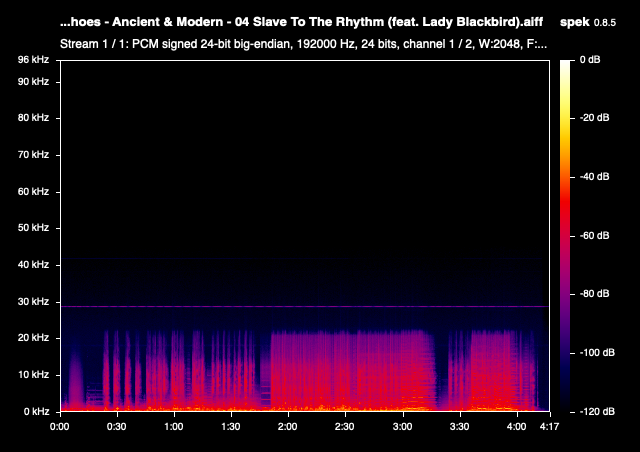
This is the image created by a spectrogram analyzer (Spek) to see what was happening under the hood. What appeared on my screen left me completely speechless...
As you can see in the image , the file used is a PCM Signed 24-bit 192000 Hz file.. The file itself is 296 Mb and cuts off musically right at the 22 kHz frequency. Above 22 kHz up to 96 kHz there is nothing but big black void. Digital air...
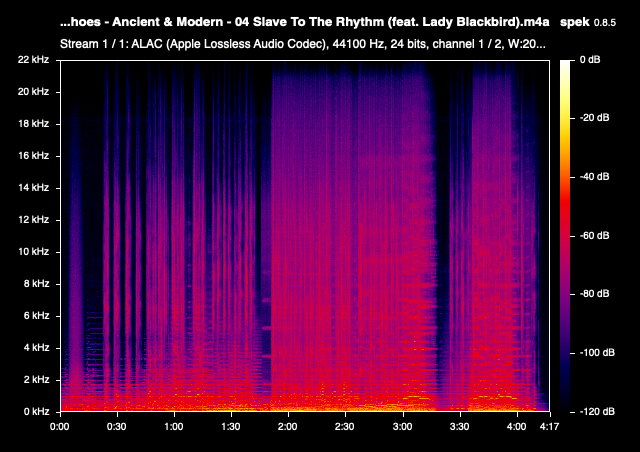
This is the spectrogram I made, again using the amazing spectrogram analyzer (Spek) which shows what happens when you re encode the file from 192 kHz to 24 bit 44.1 kHz.
All the bloated air is gone, no more artefacts or other problems and no more extremely large file. This file is now downsized to 49.8 MB.
Sadly this is obviously no longer a 24 Bit 192 kHz file but a 24 bit 44.1 kHz file. Which is not what I was buying !
Now what?
Well, establishing this shocking fact is one thing, but the technician in me wanted to know more and so I went on a quest to find out what was really happening .
So I wrote some e-mails :
1. An email to the Artist on Bandcamp which should be Trever Horn himself.
2. In case of failure, a message to Bandcamp themselves as well.
3. I wrote a message to Tidal about them selling 192 kHz files while all the time they are not really offering this quality as the file internally is a 44.1 kHz file.
4. Wrote a message to German Gramophone, the label that made the album, just to see how they will respond.
So right now, I have this large set of files which are all just blown-up 16 bit 44.1 kHz sources, just packed in extremely large containers.
I cannot imagine someone like Trevor Horn to be okay with this, especially after all the hard work he has put into this to make these albums .
Looking to hear from you too Trevor :)
Written with respect to the artists and producer of the albums.
Add comment
Comments