

Modern Old Style Rack System
I think it was around 1986 that I started to look around in Hifi shops to find a new stereo set. My then future wife and I had just entered our first apartment to live together and with that new era I felt a new stereo set was in order.
Until then I mostly used items I could buy second hand or gather from friends, like a Marantz Digital Tuner, a Sony TA Amplifier and some Philips Speakers.oh and an Akai Tangential turntable which was equipped by an Ortofon needle. Although I was quite happy with the sound of this set, it all had different sizes, was not really stackable and was somewhat outdated.
Shopping at Radio Oudeland
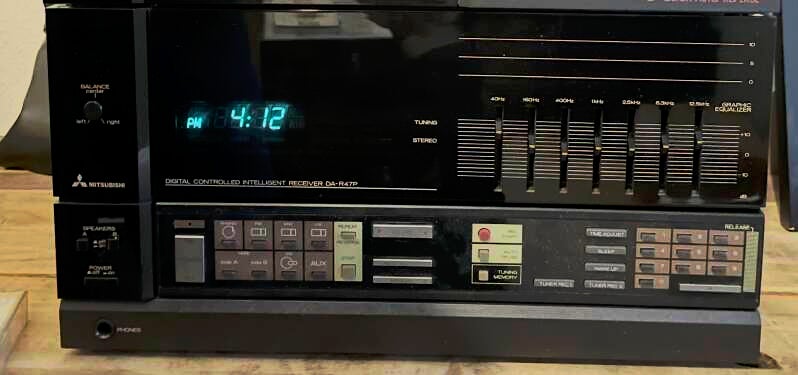
In our town where we lived we had one big shop filled with all kinds of audio equipment, Radio Oudeland. There I found this special gem the Mitsubishi DA-R47P and I was sold in an instant. The looks, the usability, the sound quality, yes sir, this was it. It wasn't cheap, I'll tell you that. But still I dug up every last cent I had and bought it.
What's so special about it
Well, that my friend was the fact that - as a starting computer nerd - I experienced the first ever completely microprocessor controlled radio system and it did everything and more.
Below the parts and their function.


DA-R47P Receiver
The receiver is the heart of the unit. It controls the power to all parts through a smart lint-cable on the back that interconnected all the parts with just one cable.
It has the 2 x 60 Watt power section and built-in digital radio with MW and FM. On the bottom is the large remote controller that can be stored there but obviously also taken out to remote control the system.
DT-47P Tapedeck
The tape deck is a special one. You have to push it to open it like a drawer and then you can horizontally mount the cassette to play. it is an auto reverse deck, so at the end of tape A it will auto revers to tape B. While playing you could push in the drawer again and would not know that the tape was playing.
Through some smart programming on the side or Mitsubishi you could forward automatically to the next song, provided there was a small silent gap between songs. The cassette would fast-forward and would stop at the " marker " , then wind back a little and start again at the new song. Brilliant for that time.

DP-47P
This is the CD player. Quite basic actually but seeing that Philips and Sony just released their first CD player ever, quite astonishing that Mitsubishi also had their version of a CD player and capable of more then the Sony/ Philips models. Again, this also had an auto forward - which in case of a CD is skip-to-next - but it all worked together. You could have toe system record the CD and create the gaps between the recordings automatically , so any tape copy would be an exact copy of the CD. The levels were set automatically by the system, brilliant !

LT-47P
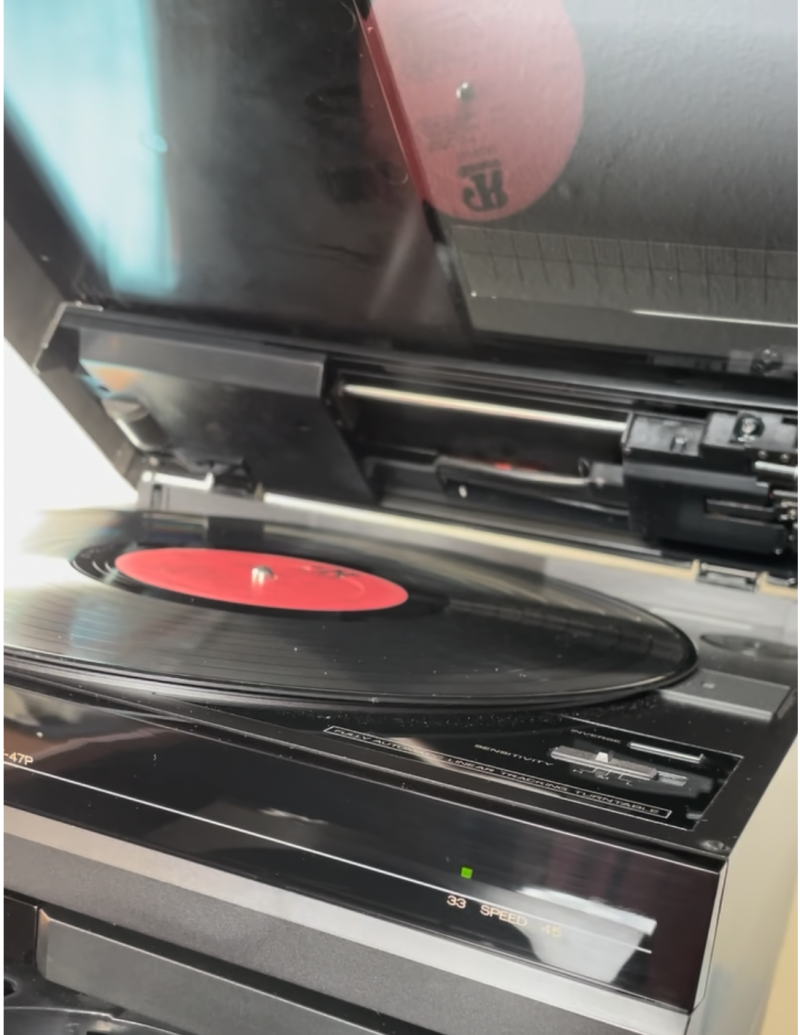
The turntable was and still is a special thing. Not som much for the platter or the needle, or the fact that it was/is a tangential turn table - which according to purists for audio equipment still is the best way to play any vinyl record - , but the most astounding thing was that it ran fully automatic.
You just put a record on the turntable, lower the big cover ( as the needle / arm section was built into the cover ) and it would start automatically from the beginning of te record.
Now skipping records was always a daunting task to do without damaging the record and Mitsubishi had worked out a system that used sound-waves ( sort of echo-location-system ) that could determine the gaps on a record. So if you wanted to skip 1 or 2 songs, just use the massive remote and skip them, the system would work out where to land the needle again.
This is still the only system that I know of that does this and I may say nearly flawlessly. It only has issues with very short intervals, logically.

After 40 years...
Well, after using this system for many years I finally sold it to someone else. Something that in hindsight I should never have done but ah well, we all make mistakes eh.
So 40 years onwards and I am back thinking about this system and started to look around if I could find some. Yes there were some lying around here and there and over a period of about 4 years I purchased and picked up 5 of these sets, most of which were trashed beyond repair or had such alterations on them that they weren't salvable or usable, but... I still managed to create one set out of all these different sets that I picked up.
It needed some minor repairs and a lot of TLC but it's back and up and running and I am as happy now as I was back then. This set now is powering a set of Klipsch RP600's and I may say, without any problems. Still as powerful as it was back then. :)
The only issue now is the fading VFD lights on the display that I need to sort out if it's the tubes that are tired or the electronics behind them. May need to find myself a specialist for this. ( fixed ! )
Update 2026:
I finally solved the issue on the VFD displays. It was a mere 1 Ohm resistor that was broken. It worked as a sort of fuse and prevented the VFD from shorting out I guess. I never understood this 'security measure' but after replacing that simple resistor, the displays came " alive" again in almost 100% light. As I had some other displays lying around from other units I have switched a few until I found the best one which is now running in the system.
Afterwards I had to meddle with the cassette deck which would not rewind properly even though playback seemed fine. Another belt that had stretched beyond what was healthy for the unit. So I took it apart to not only find a stretched belt but also the path of the belt was wrong. Apparently someone in the past had been working on the issue but had put the belt on wrongly, so it would play back but could not rewind properly or do Auto-reverse.
Auto reverse
Fun part of the Auto Reverse on this unit is that it does not do so automatically, as you'd expect. I had not used that for ages to I was searching to find why it would not auto-reverse ( as I remembered it did that lighting fast- as son as it recognised the tape was at it's end it would reverse playback and rotate the head, something quite unique ) .
After opening the system, checking it for any broken levers or similar, nothing was found... so I put it back together and in the system.
Playback was fine, manually both ways but not auto-reverse, until I noticed a button on the large remote " Reverse " which had to be pushed to turn on Auto-reverse " mode... guess after 40 years you tend to forget those intricate details :)
Add comment
Comments
Here another having nostagic feelings for this set. You skipped one other gem of the set: the tapedeck has 2 cassettes! I'm very sad I binned the set because the amplifier died , someone said blown up. I still have the original speakers with flat conusses somewhere in the back of my garage. I bought mine in 1987 together with a 37cm Mitsubishi tv. The shop installed a 3,5mm jack so my tv dropped its sound through aux.
I also am looking for this full (working) set, so if you want to get rid of it ...
Nowadays I have another special vintage set. Beomaster 3500 amp/receiver, Beogram CD3500 CD player, Beogram 2200 turntable, Beolab 8000 speakers (the pencils) and remote control Beo 4.
But the Mits would look quite nice in my hone office.
Cheers!