

Introduction
Whether you’re watching movies, gaming, or enjoying music, low frequencies bring sound to life. Bass makes the world move during epic movies or live concerts, it will bring warmth and power to voices and is considered the most essential sound in our life.
But getting the right bass isn’t just about bigger subwoofers – it’s about matching your setup to your room and equipment used. One misstep in placement, sound set-up or subwoofer size can make your bass uneven, overpowering, or even almost inaudible in certain spots.

Why One Subwoofer is Enough
For most rooms, a single, well-placed subwoofer does the job. A good 10” or 12” sub can fill a small to medium room with satisfying bass without introducing phase issues or taking up too much space.
Placement tips:
-
Corners often boost bass, but may create boomy spots.
(Placing speakers - or subwoofers - in a corner will add +3 to +6 dB in volume) -
Near walls or centrally in the room can smooth out low frequencies.
(Always preserve a minimum of 15 to 20 cm free space behind your subwoofer for best reflections) -
Experiment with small adjustments—just a few inches can make a difference.
(Some people advise to do the ' Subwoofer Crawl ' which means that you move your subwoofer around in your room to various spots to find the best spot. The best spot is where it can perform and offer the bass you want at the seating position you prefer.)

Klipsch RP-1200SW
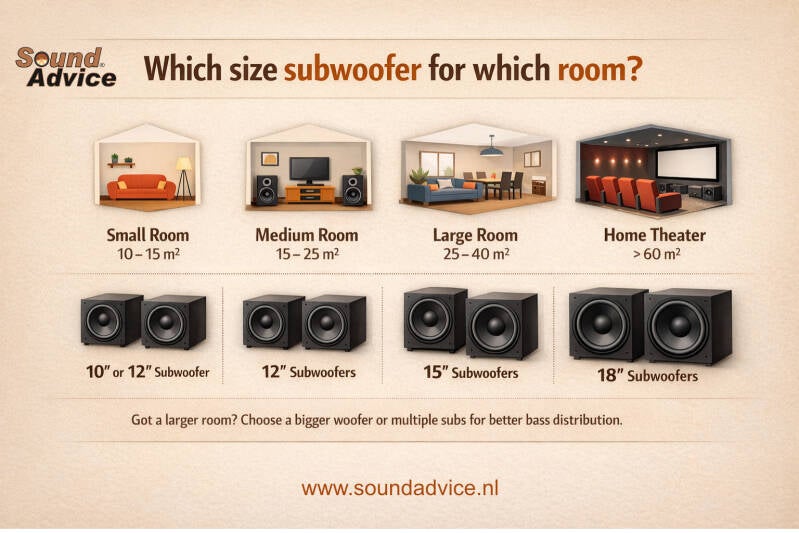
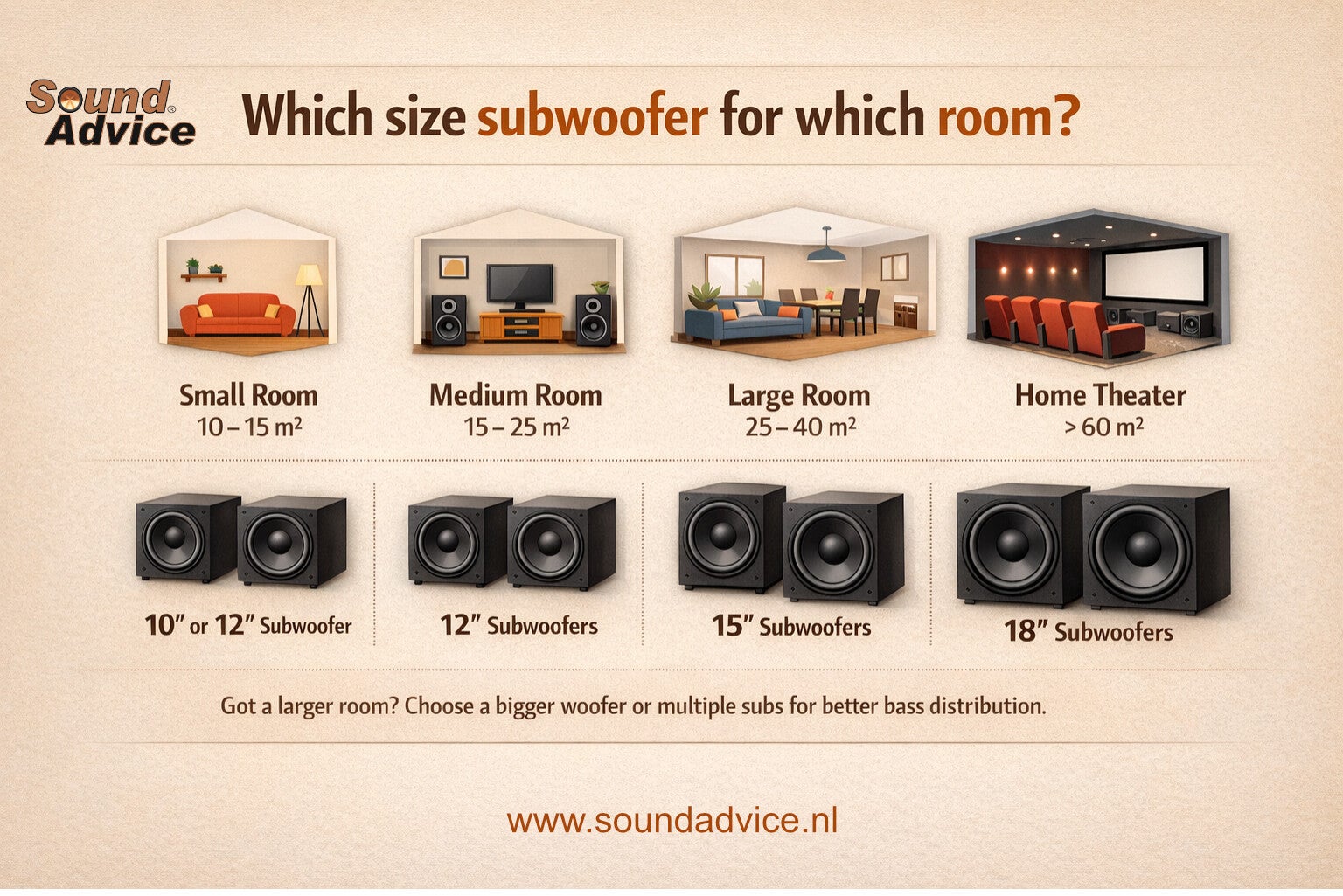
Which size subwoofer for which room
Choosing the right subwoofer size is just as important as the number of subs. Here’s a quick guide to get started:
Quick reference:
-
Small rooms: 10”–12”, 1 sub
-
Medium rooms: 12”, 1–2 subs
-
Large rooms: 12”–15”, 2 subs
-
Very large / home theater: 15”–18”, 2–4 subs
Click picture to enlarge
Common Misconceptions
-
Stacking subs: Putting multiple subwoofers next to each other or on top of each other usually doesn’t increase bass. Interference between drivers can actually make some frequencies weaker.
-
Bigger = better: A 15” or 18” sub in a small room may overwhelm the space and create uneven bass. More size doesn’t automatically mean better bass.
Set you crossover correctly
When setting up your subwoofer, it is important to consider the proper cross over settings. Most subwoofers are added to Surround Setups. As such there will be an AV Receiver powering the surround setup and this will also determine the crossover settings. To let the AV Receiver determine the crossover frequencies, you best put the volume on the subwoofer at 50% and the frequency selection all the way open.

When to Consider Multiple Subwoofers
Sometimes, one sub isn’t enough. In larger rooms, oddly-shaped spaces, or “shoebox” apartments with hard reflective walls, bass can become uneven: strong in some spots, weak in others.
Two subwoofers, placed strategically, can even out the low-frequency response across the room.
Do you need more than two?
Only if your space is very large or you want precise control, and careful adjustment of phase, delay, and levels is essential.

Practical Tips
-
Measure your room and consider listening positions.
-
Start with a single sub and add more only if needed.
-
Experiment with placement and settings.
- Subwoofers do not need to be placed along some wall, experiment by putting the subwoofer in a corner under a 45 degree angle pointing at your listening position, you may be surprised by the effectiveness of this as you get +3 to 6dB from your subwoofer.
-
Look for subs with phase adjustment or room correction for optimal results.
Conclusion
Getting the right subwoofer setup isn’t about the biggest driver or loudest decibel. It’s about matching the sub(s) to your room, placing it smartly, and tuning it carefully. Follow the guidelines above, check out our infographic above , and you’ll enjoy deep, even bass without headaches or boomy corners while keeping some money in your pocket.
Create Your Own Website With JouwWeb